

Electrical red flags when buying a house are easy to miss. You walk through the rooms looking at the kitchen, the light and the yard, not at the panel in the garage. Yet the electrical system is one of the most expensive things to fix after you move in, and some problems are a fire risk from day one. This guide lists twelve red flags you can spot yourself, at the showing or in the inspection report, and what to do about them before you sign.
In fifteen years of inspecting electrical installations in Belgium, I learned that the panel tells you most of the story. So that is where we start.
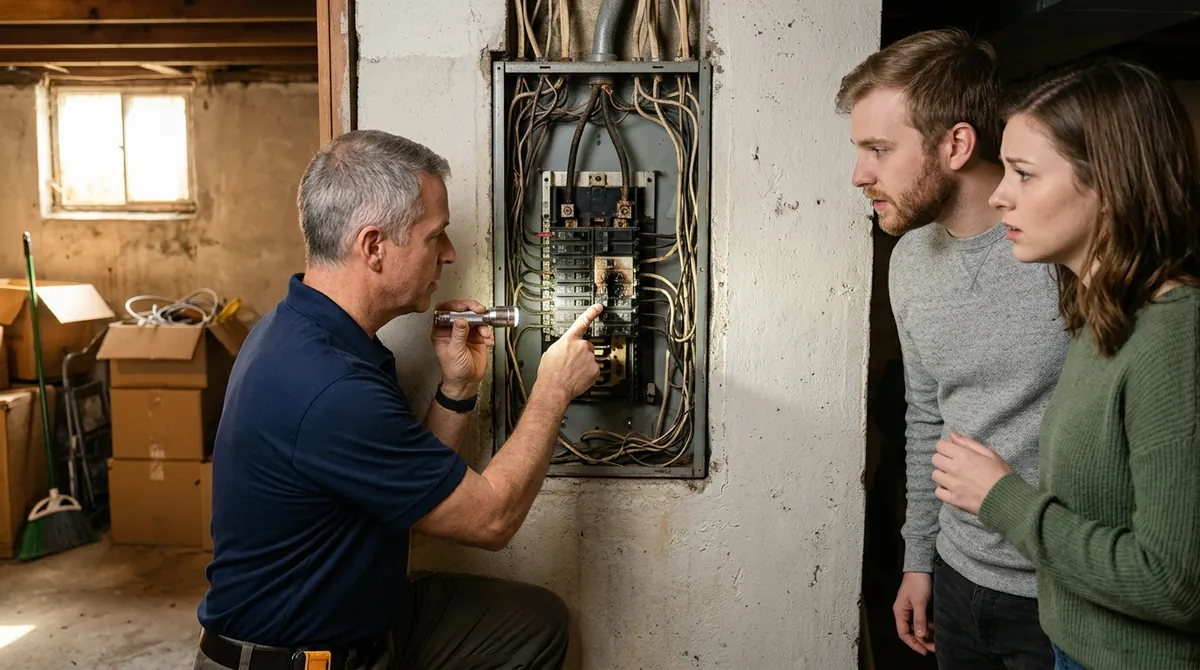
Electrical red flags in the panel
1. A Federal Pacific or Zinsco panel. Look at the label inside the panel door. Federal Pacific Electric panels with Stab-Lok breakers, and Zinsco panels, have a long record of breakers that do not trip when they should. Some insurers will not cover a house with one. Read more in our articles on why Federal Pacific and Zinsco breakers fail and on replacing a Federal Pacific panel.
2. A service too small for how you will live. A 60 or 100 amp service was fine for the house in 1970. It may not be fine once you add an EV charger, a heat pump or an induction range. Check the rating on the main breaker, then compare it with your plans. Our decision helper tells you whether you will likely need an upgrade, and our article on the 200 amp panel upgrade explains what it costs.
Planning an EV charger or a heat pump? Check it first with the service upgrade decision helper.
3. Double tapped breakers and a crowded panel. Two wires under one breaker terminal that is not rated for it, a panel full of tandem breakers, or wires stuffed in so tightly the cover barely closes: these are signs that circuits were added over the years without anyone planning the panel. Read why it matters in our article on double tapped breakers.
4. Rust, water stains or scorch marks. Rust inside the panel means water got in. Brown or black marks around a breaker mean it ran hot. Both deserve a licensed electrician before closing, not after.
Electrical red flags in the wiring
5. Knob and tube wiring. Common in homes built before the 1950s. You can sometimes see the white ceramic knobs and tubes in an unfinished basement or attic. It has no ground wire and was never meant for today’s loads, and many insurers ask about it. Whether you really need to rewire is explained in our article on old house wiring.
6. Aluminum branch circuit wiring. Used in many homes built from the mid 1960s to the mid 1970s. The problem is not the aluminum itself but the connections at outlets and switches, which can loosen and overheat. Look for “AL” printed on the cable jacket in the basement or at the panel. See our article on aluminum wiring replacement.
7. Do it yourself wiring. Extension cords stapled to walls as permanent wiring, splices without a junction box, open boxes without covers, or cable hanging loose in the basement. Every one of these tells you someone worked without a permit. Ask the seller whether the basement, the garage or an addition was finished with an electrical permit.
Electrical red flags you can spot at the showing
8. Two prong outlets everywhere. They usually mean the circuits have no ground wire. That is not automatically illegal, but it limits what you can safely plug in. Our article on two prong outlets explains the three legal options.
9. No GFCI protection where water is. Look for outlets with Test and Reset buttons in the kitchen, the bathrooms, the garage, the laundry and outside. If you see none, the house is missing one of the most effective life saving devices in a home. See where the NEC wants them in our article on GFCI requirements.
10. Warm outlets, buzzing switches or a burning smell. Put the back of your hand on a few cover plates and listen near switches. Warmth, buzzing, a fishy or burning smell or discolored plates point to a loose connection. A common cause is outlets wired with push-in connections, explained in our article on backstabbed outlets.
11. Lights that flicker or dim when something starts. A short dip when the air conditioner kicks in can be normal. Lights that flicker all over the house, or a whole room that dims, can point to a loose connection in the panel or in the service. That one is worth a closer look.
12. A damaged meter base or service cable. Walk around the outside. A meter base pulling away from the wall, a cracked cable jacket or a service mast that leans are not cosmetic. That service entrance cable has no breaker of its own, and repairs on the utility side need the power company.
What to do when you find electrical red flags
- Read the home inspection report closely. The electrical section is often a list of short notes. Our article on the 22 findings in every electrical inspection report tells you which ones are urgent and which are not.
- Get a licensed electrician’s quote before closing. A home inspector points out problems. An electrician tells you what the repair really involves and what it costs.
- Put a number on it. Use our electrical repair cost estimator to get a first range, then use the quote to negotiate a lower price or a repair credit.
- Call your insurer. Ask before you sign whether they will cover a house with the panel or wiring you found.
Electrical red flags are not always a reason to walk away. Many of them have a known fix and a known price. What hurts is finding them after closing, when the cost is all yours. Look at the panel, read the report, and get a real quote while you can still negotiate.
This article is general information about residential electrical systems, not a code ruling for your home. Code adoption varies by state and city, and your local electrical inspector has the final word. Have any work done by a licensed electrician.

Who writes this
FIXMIRO is written by Rahmouni, an industrial engineer who spent fifteen years inspecting electrical installations and seven inspecting gas. What you read here is what he used to explain to homeowners while standing at their panel, written out properly.
Use the free calculatorsOr browse all the guides.