

Service entrance cable is the heavy cable that brings power from the utility to your main breaker. Almost nobody thinks about it, yet it is the most dangerous wire in your house. Every other wire in your home is protected by a breaker. This one is not.
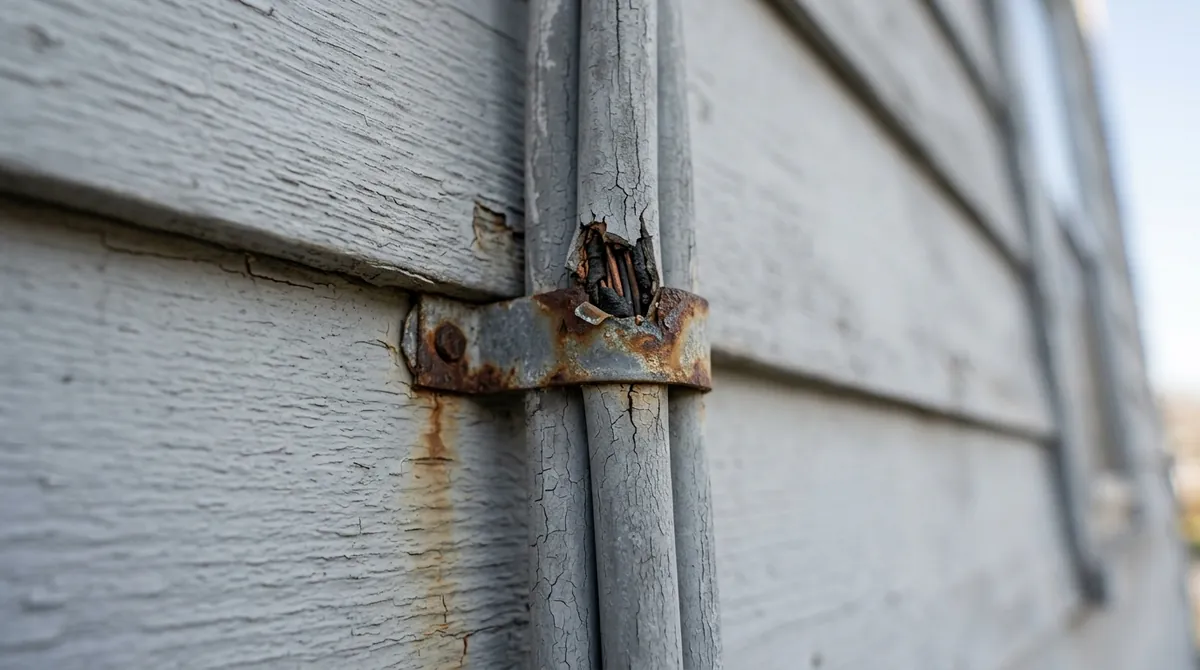
Service entrance cable: why no breaker trips
Drive a nail through a branch circuit in your wall and the breaker in your panel trips in a fraction of a second. The power is gone. Drive the same nail through the service entrance cable and nothing in your house trips. That cable sits upstream of your main breaker. The first protection is at the utility side: a fuse on the pole, or the protection of the transformer that feeds your street.
That utility protection is sized for a transformer that may feed several homes. It only reacts to a very large current. And close to the transformer, the current available in a short circuit can be huge. As an example, a 50 kVA transformer at 240 volts with an impedance of 2 percent can deliver about 10,400 amps at its terminals. You can estimate the number for your own home with the available fault current calculator.
There is a catch that makes it worse. An arc is not a clean short circuit. The arc itself has resistance, so the current is lower than the theoretical maximum. A large utility fuse can then take a long time to open, while the arc keeps burning. The result can be:
- an arc flash with temperatures of thousands of degrees;
- a deadly electric shock for whoever is holding the drill or the shovel;
- a fire inside the wall, the basement or the trench.
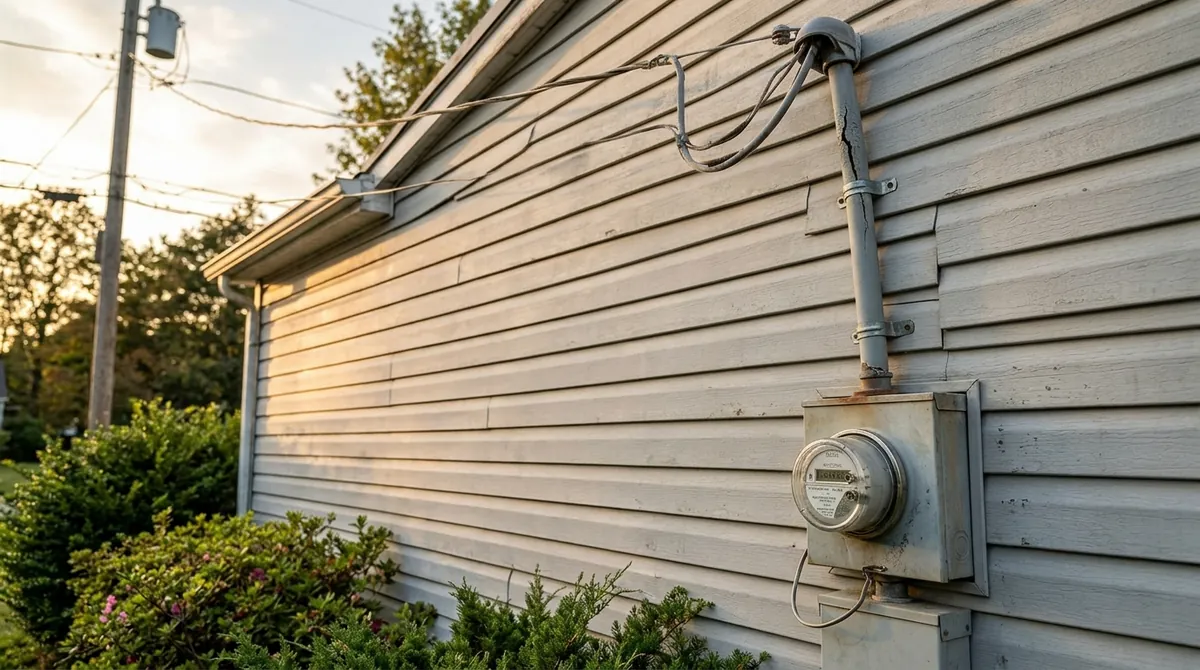
How the NEC keeps this cable short
The NEC knows this cable is unprotected, and it tries to limit how much of it runs through your house. The service disconnect must be installed at a readily accessible location, either outside or inside nearest the point where the service conductors enter the building (NEC 230.70(A)(1)). The less unprotected cable inside, the less there is to hit.
Since the 2020 NEC, one and two family dwellings also need an emergency disconnect at a readily accessible outdoor location (NEC 230.85). Firefighters can then cut the power before they go inside. Not every state or city has adopted that edition yet, so check with your local inspector. If you are planning a 200 amp panel upgrade, this is a good moment to ask about it.
Interestingly, the European rules do not go that far. In fifteen years of inspecting electrical installations in Belgium, I often saw a long, unprotected cable running through a garage or basement to a panel at the other end of the house. The Belgian code simply stops at the meter. More on how the two systems differ in my article on the home grounding system.
Service entrance cable on a building site: five rules
- Call 811 before you dig. It is free, and the utility will mark where its lines run.
- Dig by hand near the marks. Never use an excavator close to a buried service line.
- Watch the bends. A cable rarely runs in the perfectly straight line you expect.
- Protect the cable on site. Keep heavy material, ladders and temporary power poles away from where it enters the house.
- Never drill blind near the meter. In an existing home, do not drill, nail or cut anywhere near the path from the meter to the main panel.
New construction is where most damage happens. If your home is being built or renovated, the inspector will look at the service during the rough-in electrical inspection, but nobody is watching the trench every day. That part is up to you and your contractor.
Apartment buildings: many unprotected cables in one shaft
In apartment buildings the risk adds up. The meters are often grouped in a meter room or on each floor, fed by risers that run up through a shaft. Ten or more large conductors can share the same space, all upstream of the tenants’ breakers.
An arc in a closed shaft is far worse than one in the open. The hot gas has nowhere to go, so the pressure rises in a fraction of a second and can push flames and smoke out of every access panel. A vertical shaft also acts like a chimney: fire and toxic smoke from burning insulation travel upward in seconds, toward the residents on the top floors. If you manage or own a building, ask an electrician to look at the condition of the risers and the fire stopping where they pass through each floor.
The cable nobody thinks about
Your breakers protect everything after the main panel. The service entrance cable is the one part they cannot protect. Know where it runs, keep tools away from it, and treat it with the respect it deserves. If the meter base or the cable looks damaged, call the utility, not a handyman. And for any planned work near it, check whether you need an electrical permit.
This article is general information about residential electrical systems, not a code ruling for your home. Code adoption varies by state and city, and your local electrical inspector has the final word. Have any work done by a licensed electrician.

Who writes this
FIXMIRO is written by Rahmouni, an industrial engineer who spent fifteen years inspecting electrical installations and seven inspecting gas. What you read here is what he used to explain to homeowners while standing at their panel, written out properly.
Use the free calculatorsOr browse all the guides.