

Home grounding system is a phrase most people only hear when something goes wrong: an inspector flags a missing ground rod, a receptacle tester lights up “open ground”, or an electrician says the panel needs a new bonding jumper. Yet the way your house is grounded decides what happens in the first fraction of a second after a fault, and why the breaker in your panel can protect you at all. In fifteen years of inspecting electrical installations in Belgium, I worked with a completely different system. Comparing the two is the clearest way I know to explain how yours works.
Home grounding system: what it has to do
Picture a metal washing machine. Inside, a hot wire chafes through its insulation and touches the cabinet. From that moment the cabinet is at 120 volts. Anyone who touches it while standing on a concrete floor becomes a path to ground.
Every home grounding system has the same job in that situation: get the current off the cabinet and get the circuit shut down, fast. Where the systems differ is the road the fault current takes, and therefore which device does the shutting down.
How an American house clears a fault
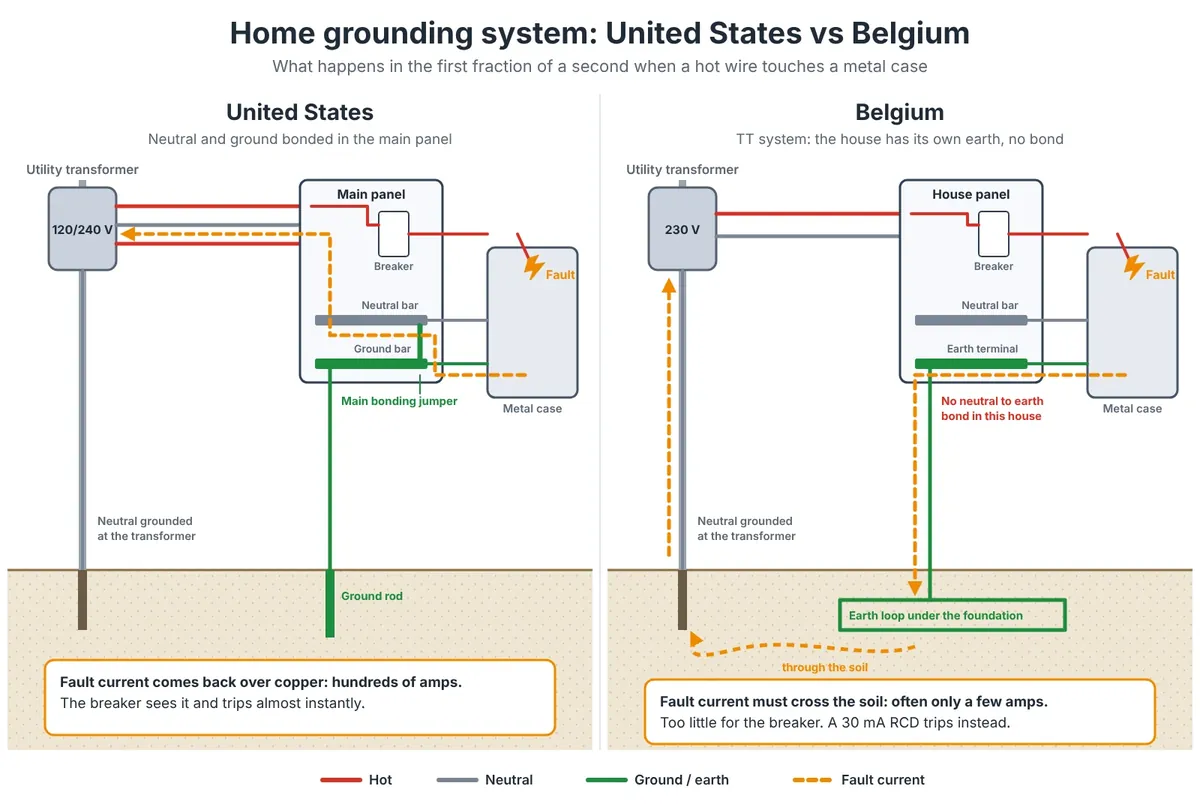
In a typical American house, the utility transformer on the pole or the pad feeds your service with two hot conductors and a neutral. That neutral is grounded at the transformer and at many points along the utility’s lines. At your main panel, the neutral bar and the grounding bar are tied together by the main bonding jumper. That is the only place in the house where neutral and ground meet.
From the main panel, every circuit runs with its own equipment grounding conductor: the bare or green wire in the cable. That wire connects to the metal cabinet of the washing machine. Now follow the fault:
- The hot wire touches the cabinet.
- Current flows through the equipment grounding conductor back to the main panel.
- At the panel, it crosses the main bonding jumper onto the neutral.
- The neutral carries it back to the transformer.
That whole loop is copper and aluminum. Its resistance is a fraction of an ohm, so the fault current is not a few amps but hundreds or thousands of amps. A 20 amp breaker sees that as a short circuit and trips almost instantly on its magnetic trip. How much current your panel can actually deliver in a fault is explained in our article on available fault current at the panel.
Estimate the fault current at your own panel with the available fault current calculator.
In the international language of electrical standards, this is a TN system, more precisely TN-C-S: the utility combines neutral and ground in one conductor, and your service splits them into two at the main panel.
So what does the ground rod do?
Most homeowners assume the ground rod is where fault current goes. It is not. The NEC says so in plain words: the earth shall not be considered an effective ground-fault current path (2023 NEC 250.4(A)(5)).
Run the numbers and you see why. A single ground rod is acceptable if it measures 25 ohms or less; otherwise a second electrode is required (250.53(A)(2)). Suppose the fault current had to go through the earth: 120 volts across 25 ohms at your rod plus a few ohms at the utility side gives roughly 4 amps. A 20 amp breaker would never trip. The cabinet would sit at a dangerous voltage indefinitely.
The grounding electrode system has other jobs. It ties your house to the earth so that lightning and surges on the utility lines have a place to go, and it keeps the voltage of your system stable relative to the ground you stand on. Many newer houses use a concrete-encased electrode, often called a Ufer ground: at least 20 feet of rebar or bare copper in the footing (250.52(A)(3)). The inspection of that electrode happens before the concrete is poured, which is why some jurisdictions schedule a separate visit for it, as described in our article on the rough-in electrical inspection.
How a European house clears the same fault
In Belgium, where I inspected for fifteen years, most houses are on what the standards call a TT system. The utility grounds its transformer, but your house does not get a grounded conductor from the utility to bond to. Instead, the house has its own earth electrode: a copper loop buried under the footings, or ground rods. The equipment grounding conductors of the house connect only to that electrode.
Now follow the same washing machine fault. The current goes from the cabinet through the grounding conductor to the house electrode, through the soil to the transformer’s electrode, and back to the transformer. The soil is in the loop. With an earth resistance of 30 ohms at the house and 230 volts, the fault current is around 7 amps. A breaker will not trip on that.
That is why every Belgian house has a residual current device, the equivalent of your GFCI, at the head of the panel, and a set of 30 milliamp devices behind it. In a TT system the residual current device is not an extra layer. It is the protection. Without it, a fault on a metal appliance would simply stay there.
Home grounding system side by side
| United States (TN-C-S) | Belgium (mostly TT) | |
|---|---|---|
| Voltage to ground | 120 V | 230 V |
| Where fault current returns | Through copper, via the neutral | Through the soil |
| Typical fault current | Hundreds to thousands of amps | A few amps |
| What trips first | The circuit breaker | The residual current device |
| Role of the ground electrode | Lightning, surges, stable reference | Part of the fault current path |
| Shock protection devices | GFCI where the NEC requires it | 300 mA at the panel, 30 mA on most circuits |
| Testing | Newer GFCIs test themselves automatically | Manual test button; after a manual test the device may not switch itself back on |
Neither system is better in every way. The American approach clears a fault through the breaker you already have, with no extra device. The European approach does not depend on a low-resistance metal path all the way back, but it depends completely on a working residual current device and on a decent earth electrode. Where shock protection matters most, both end up in the same place: the GFCI in your bathroom, which trips at around 5 milliamps, and the 30 milliamp device in a Belgian bathroom do the same job. Where the NEC requires that protection is covered in our guide to GFCI requirements, and how the two approaches play out in one room is in what a European inspector noticed about American bathrooms.
Where an American home grounding system goes wrong
Because your protection depends on that low-resistance copper path, anything that breaks it matters more than people think. The defects that come up again and again:
- No equipment grounding conductor at all. Older houses with two prong receptacles have no ground path. A fault on a metal appliance has nowhere to go. Your legal options are explained in two prong outlets in an old house.
- Neutral and ground bonded in a subpanel. They may only meet at the service. If they are also bonded in a subpanel, normal neutral current flows on grounding conductors and metal parts (250.24(A)(5)). This is one of the most common mistakes in garage and shop panels, covered in our article on a subpanel in a detached garage.
- A missing or loose main bonding jumper. Without it, the fault current has no road back to the neutral, and your house behaves like a poorly grounded TT system with no residual current device. The breaker will not trip.
- “Bootleg” grounds. A jumper from the neutral to the ground screw on a receptacle makes a tester show “correct”, but it puts the metal of the appliance on the neutral. If that neutral ever opens, the cabinet becomes live.
- A single ground rod nobody ever measured. It will not stop your breaker from working, but it is a common report finding, listed among the 22 findings in every electrical inspection report.
What you can check yourself
- Know which GFCIs you have. Since 2015, GFCI receptacles sold in the US must test themselves automatically and signal when they fail, usually with a light or by cutting power. Older GFCIs cannot do that, so press their test button once a month. Manufacturers still recommend a monthly test on the newer ones too. If a GFCI does not trip, have it replaced.
- Use a plug-in receptacle tester on three prong outlets. “Open ground” or “hot/neutral reversed” means the circuit needs an electrician.
- Look at where your service enters the house. You should see a heavy copper conductor running from the panel or meter base to a ground rod, a water pipe or the foundation.
- If you have a subpanel, ask your electrician to confirm that its neutral and ground bars are separated.
A home grounding system is the part of the installation nobody sees and everybody assumes is fine. Knowing how the fault current gets back to the panel tells you why each of these checks matters.
This article is general information about residential electrical systems, not a code ruling for your home. Code adoption varies by state and city, and your local electrical inspector has the final word. Have any work done by a licensed electrician.

Who writes this
FIXMIRO is written by Rahmouni, an industrial engineer who spent fifteen years inspecting electrical installations and seven inspecting gas. What you read here is what he used to explain to homeowners while standing at their panel, written out properly.
Use the free calculatorsOr browse all the guides.