

Ask around and you will be told that these panels are dangerous, that they cause fires, that they should come out. What you will almost never be told is what actually happens inside the breaker at the moment it is supposed to save you and does not.
Why Federal Pacific breakers fail is not a dramatic story. Nothing burns out, nothing snaps. The parts simply stop moving. And Zinsco, which gets mentioned in the same breath, fails somewhere else entirely and for a completely different reason.
This is the technical half. If what you actually want is whether to replace yours, what it costs and what your insurer will say, that is the other article: do you have to replace a Federal Pacific panel.
What a breaker does when it works
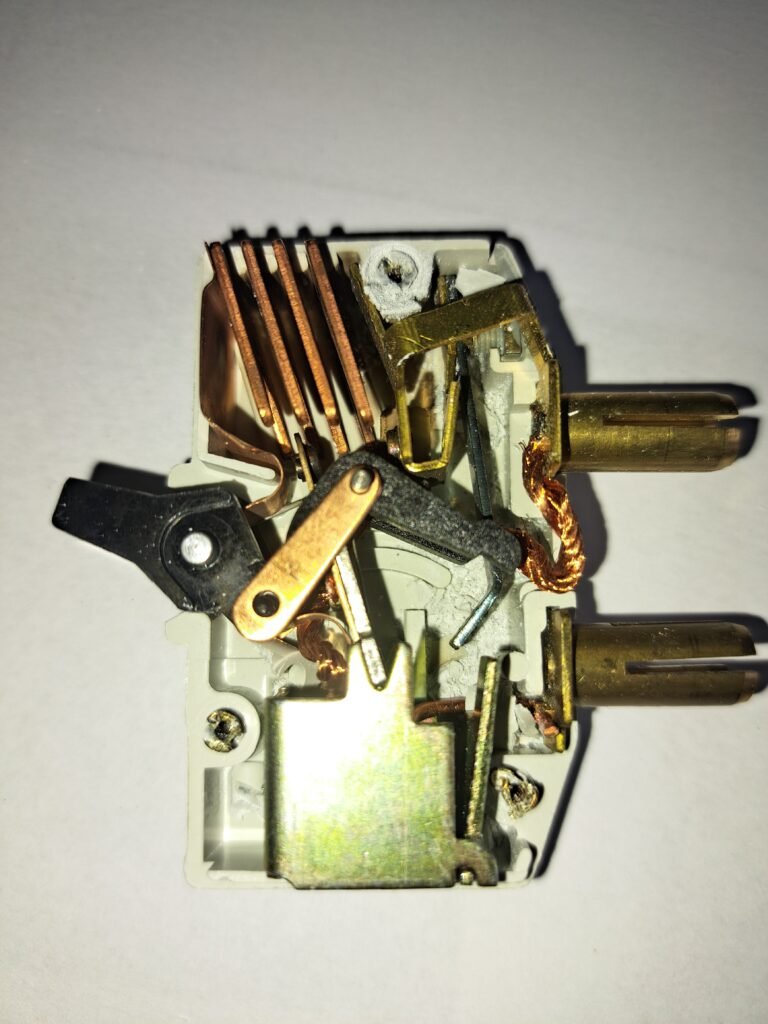
You cannot see what is broken until you know what is supposed to happen. A breaker does two separate jobs, with two separate mechanisms, inside one small housing.
The overload job, and it is slow on purpose. A strip of two different metals bonded together carries the current. Push more through it than it is rated for and it heats, and because the two metals expand at different rates, it bends. Slightly overloaded it takes minutes. Heavily overloaded, seconds. That curve is not sloppiness. It follows the way a cable heats up, and a cable can carry a modest overload briefly without harm. The breaker is built to allow exactly that and nothing beyond it.
The short circuit job, and it is fast. A coil around the same current path becomes an electromagnet. At fault currents of hundreds or thousands of amps it throws an armature across in a few thousandths of a second, long before the bimetal has even warmed up.
Both end in the same place: they release a latch. The latch holds a spring under tension. Let it go and the spring pulls the contacts apart faster than any hand could, and the arc that forms between them is driven up into a stack of steel plates that stretches it, cools it and cuts it into pieces until it dies.
One more detail, and it matters for everything below. A breaker is trip free. Hold the handle in the on position with your thumb and it must open anyway. The handle moves the mechanism, but the mechanism releases independently of the handle. A breaker you can hold closed is not a breaker.
That is the entire design. Every part of it depends on small components moving freely at the one moment they are asked to.
Why Federal Pacific breakers fail: the parts bind
Now the answer, and it is almost disappointingly simple.
Design and manufacturing tolerances combine so that a share of these breakers jam internally. The bimetal bends the way it should. The latch should let go, and it does not, or not until well past the current and the time where it should have.
Nothing about that shows from the outside. The handle is on. The lights work. The circuit behaves perfectly normally right up to the day it needs the breaker and does not get it.
There is a second stage that makes it worse. A breaker that has jammed once has usually been through the heat of the event that jammed it. The next overload finds it more stuck, not less. So the failure is not random, it accumulates.
That is the mechanical answer to why Federal Pacific breakers fail, and it explains the test results. When breakers pulled from service were tested, a meaningful share did not trip. Not because they were destroyed, but because they would not move.
Two more weak points in the same housing
The stab. The connection to the bus bar is a blade pushed into a clip, and the fit is not generous. Score marks on the blades turn up in the field, and so do breakers somebody taped into place because they would not stay seated. A stab that does not sit tight runs warm, and a warm connection only ever gets worse. This is the same feedback loop that kills a Zinsco, further along.
Two pole breakers. They carry an extra job: linking two mechanisms so both poles open together. One more moving part in the same crowded housing, and it shows in the testing. Two pole units failed at a much higher rate than single pole ones. Those are the breakers on your range, your dryer and your air conditioner. The biggest circuits in the house, protected by the least reliable part of the range.
A breaker also has to be able to interrupt the fault current available at its terminals, which is a separate question from whether it trips at all. Our free available fault current calculator works that out for your service.
Zinsco: the mechanism works and it still does not save you
Zinsco sold its breakers under the name Magnetrip, and the name was a promise. Overload warms a bimetal strip until it bends. A short circuit builds a magnetic field that throws the mechanism open in a fraction of a second. On paper that is a good breaker, and it is the same principle a modern one uses.
The problem was never the promise. It is what the rest of the panel does to it over thirty years.
A Zinsco breaker does not clip onto the bus, it slides on, and the contact is a spring pressing against aluminum. Aluminum grows an oxide layer. Oxide raises the resistance of the joint. Resistance makes heat. Heat anneals the spring so it presses less hard, which raises the resistance again. It is a runaway, and it runs on a timescale of years rather than seconds.
Give it enough time and the joint gets hot enough to soften the plastic body and fuse the parts inside it together.
Now watch a fault arrive. The magnetic field builds exactly as designed. The mechanism tries to open, exactly as designed. And it cannot, because a magnetic field sized to flick a latch is nowhere near strong enough to tear apart metal and plastic that have welded themselves into one piece. The handle stays where it is. The current keeps flowing. The conductors heat until something else gives, and the something else is usually the panel.
Sit with that for a second, because it is the difference between the two brands. A Federal Pacific breaker fails because its own parts bind. A Zinsco breaker is not broken at all. It still works, it still moves, and it is being physically held shut by the panel it lives in.
The second Zinsco ending is quieter. The bus itself pits and burns away where the breaker sits. Then no breaker will make a proper connection in that slot, including the brand new one somebody just charged you for. That is why replacing a Zinsco breaker on a damaged bus fixes nothing.
What all of this looks like from the outside
Nothing. That is the point, and it is worth saying plainly.
A jammed Stab Lok looks like a working breaker. A fused Zinsco looks like a working breaker. The handle is on, the lights are on, and every appliance in the house behaves.
What can be seen is the damage around them, and that is what an inspector looks at when the cover comes off:
- browning or scorching around the breaker slots
- pitting on the bus bar where a breaker seats
- a faint smell of melted plastic
- a breaker that will not stay seated, or one that somebody has taped
- breakers that will not stay on, or lights that dim when a large appliance starts
On a Zinsco, look past the breakers at the bus behind them. That surface tells you more than the brand name on the door.
Panels of this age usually collect a few other findings at the same time. We listed the ones that come back in report after report in the twenty two findings that fill inspection reports.
One warning. With these two brands, do not test a breaker by tripping it yourself. If it is jammed or fused you will not discover that by flipping the handle. You will discover it on the day something actually faults.
So what do you do with it
That is the other half of the question, and it turns on things this article cannot answer: what your panel looks like inside, what your insurer says, and whether you are selling.
I wrote that up separately, with the documented record from the Consumer Product Safety Commission and the courts, the three options honestly compared, what a replacement costs and a short way to decide: do you have to replace a Federal Pacific panel.
And if you want to check for yourself that no rule requires replacement, the National Electrical Code is published by the NFPA.
Questions people ask
Why do Federal Pacific breakers fail? The moving parts inside bind, so the latch does not release when the bimetal or the magnet tells it to. Nothing burns out and nothing visibly breaks, which is exactly why it goes unnoticed.
Do all of them fail? No. Testing found a meaningful share, concentrated in two pole breakers. Single pole units performed considerably better. That is why condition matters more than the brand name alone.
Is a Zinsco breaker the same problem? No. A Zinsco breaker usually still works. The connection to the aluminum bus overheats and fuses, and the mechanism cannot pull itself free of that.
Can I test my own breaker? Not usefully, and not safely with these two brands. Flipping the handle tells you the handle moves. It does not tell you the breaker will open under fault current.
Does a new breaker fix a Zinsco panel? Not if the bus is damaged where it seats. The new breaker meets the same burned surface as the old one.

Who writes this
FIXMIRO is written by Rahmouni, an industrial engineer who spent fifteen years inspecting electrical installations and seven inspecting gas. What you read here is what he used to explain to homeowners while standing at their panel, written out properly.
Use the free calculatorsOr browse all the guides.