

Double tapped breakers show up in a large share of home inspection reports, usually as one short line with a photo of the panel. A double tapped breaker is a breaker with two wires under a terminal that was built to hold one. It often works for years, which is exactly why it gets ignored.
Double tapped breakers: what they are
Each breaker has a terminal where the circuit wire is clamped under a screw. Most breakers are designed and tested for one wire in that terminal. When someone adds a second circuit and the panel is full, the quick solution is to slide a second wire under the same screw. That is a double tap.
You may also see the term double lugging. It means the same thing and is used more often for the large terminals of the main breaker or the service wires.
Double tapped breakers: why inspectors flag them
The problem is the connection, not the breaker itself.
- A screw that presses on two round wires rarely grips both equally. One wire can sit loose even when the screw feels tight.
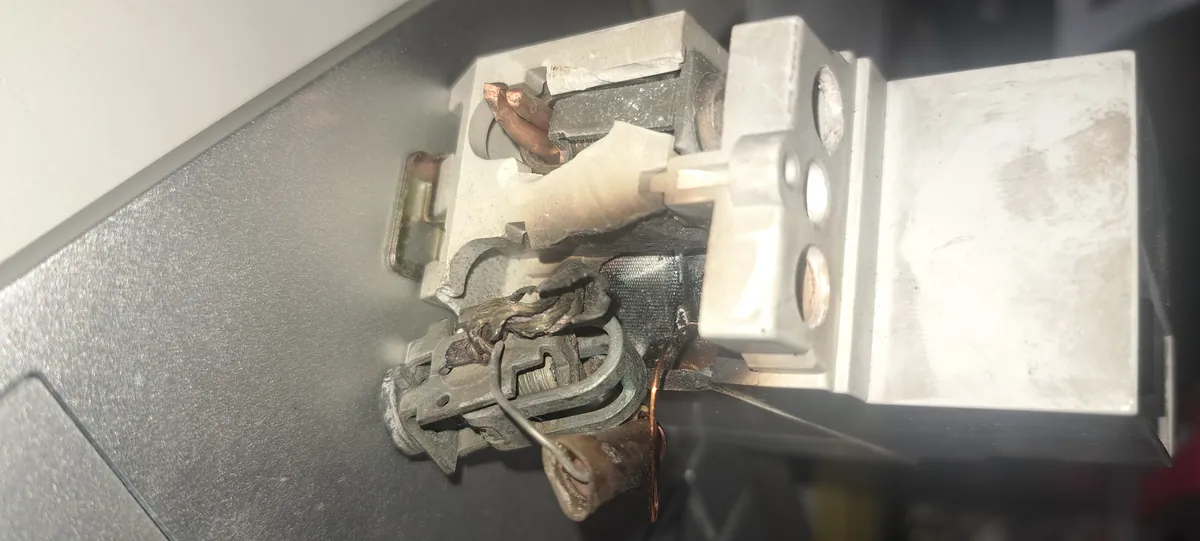
- A loose connection has higher resistance. It heats up under load, cools down, and loosens further over time. The end stage is arcing, a scorched terminal or melted insulation.
- Two wires of different sizes make it worse, because the screw bottoms out on the thicker one.
- Mixing copper and aluminum under one screw adds corrosion to the list. If your house has aluminum branch wiring, treat this as urgent.
The code side is simple. The NEC requires a terminal that takes more than one wire to be identified for that use, and equipment has to be installed according to its listing and labeling. If the breaker label does not say two wires are allowed, they are not.
In fifteen years of inspecting electrical installations, loose terminals were among the defects I saw most, and two wires under one screw was a classic cause. The photo below shows where that ends.
When a double tapped breaker is allowed
Some breakers are built for two wires. Certain Square D and Cutler Hammer breakers in the common small sizes have a terminal with a plate that holds one wire on each side of the screw. The label on the side of the breaker shows the permitted wire sizes and whether one or two conductors are allowed.
So a double tap is not automatically a defect. An inspector who cannot read the label without pulling the breaker will usually flag it and recommend review by an electrician. That is a fair call, not an error.
The load question behind the tap
Fixing the terminal does not answer the second question: what are those two wires feeding? Two circuits on one breaker share one rating. If both carry real loads, the breaker may trip often, and the fix at the terminal does not change that.
Not sure what the two circuits add up to? Run the numbers with the circuit load calculator before you decide on a fix.
How an electrician fixes it
- Pigtail. The two circuit wires are joined with a short third wire in a listed connector, and only that one wire goes to the breaker. This is the usual repair when the combined load is small.
- A separate breaker. If the panel has a free space, each circuit gets its own breaker. This is the cleanest result.
- A tandem breaker. A tandem puts two breakers in one space. It is only an option when the panel label allows tandems in that position.
- A breaker listed for two wires. If the panel brand offers one in the right size, swapping the breaker solves it.
- More room. A panel with no space left and several taps is telling you something. A subpanel or a panel upgrade may be the real answer.
None of these is a big job in a healthy panel. It is still work inside a live panel, where the service wires stay energized even with the main breaker off, so leave it to a licensed electrician. Ask your building department whether the repair needs an electrical permit. A simple pigtail often does not, a new breaker or a subpanel often does. For a first idea of what the repair costs, try the electrical repair cost estimator.
Double taps on neutrals and at the main lugs
Look beyond the breakers. Two neutral wires under one screw on the neutral bar is a similar finding: each neutral needs its own terminal, so that one circuit can be disconnected without loosening another.
A tap at the main lugs or on the service wires is more serious. Those wires sit ahead of the main breaker, so a wire added there may have no overcurrent protection that matches its size. Have that one looked at soon.
What it tells you about the rest of the panel
One double tap in a tidy panel is a small repair. Several of them, together with other items from the list of common inspection report findings, suggest years of additions without a plan. In an older house that is a reason to have the whole panel reviewed. If the panel itself is a Federal Pacific panel, the tap is not your main problem.
The short version
Double tapped breakers are flagged because two wires under a terminal made for one tend to work loose and overheat. Check the breaker label, check the load, and have an electrician pigtail the wires or give each circuit its own breaker.
This article is general information about residential electrical systems, not a code ruling for your home. Code adoption varies by state and city, and your local electrical inspector has the final word. Have any work done by a licensed electrician.

Who writes this
FIXMIRO is written by Rahmouni, an industrial engineer who spent fifteen years inspecting electrical installations and seven inspecting gas. What you read here is what he used to explain to homeowners while standing at their panel, written out properly.
Use the free calculatorsOr browse all the guides.