

Breaker keeps tripping? Then the breaker is doing its job, and it is telling you something specific. A breaker reacts to only a handful of things: too much current for too long, a short circuit, current leaking to ground, or arcing. In fifteen years of inspecting electrical installations, I learned that the moment a breaker trips says more than the trip itself. Once you know what each kind of trip looks like, you can usually tell the cause from when and how it happens. This guide explains the causes, gives you a safe way to narrow it down, and tells you when to stop resetting and call a licensed electrician.
Breaker keeps tripping: what a breaker actually reacts to
A standard breaker in an American panel is a thermal magnetic breaker. It has two trip mechanisms in one small housing. GFCI, AFCI and dual function breakers add electronic protection on top of that. Together they cover four kinds of trouble:
- Overload. More current than the circuit is rated for, flowing for a while. A bimetal strip inside the breaker heats up and bends until it releases the latch. The further over the limit, the faster it trips: a slight overload can take many minutes, a heavy one a few seconds.
- Short circuit. The hot wire touches the neutral or another hot wire, and the current jumps to hundreds or thousands of amps. A magnetic coil in the breaker trips almost instantly, often with a loud snap.
- Ground fault. Current leaves the circuit through a path it should not take: the ground wire, water, a metal pipe or a person. A large ground fault trips a standard breaker the same way a short circuit does. A small one does not, which is why GFCI protection exists. A GFCI compares the current going out with the current coming back and trips on a difference of only a few thousandths of an amp.
- Arc fault. An AFCI breaker looks at the shape of the current and recognizes the pattern of arcing, the kind of sparking a damaged wire or a loose connection produces.
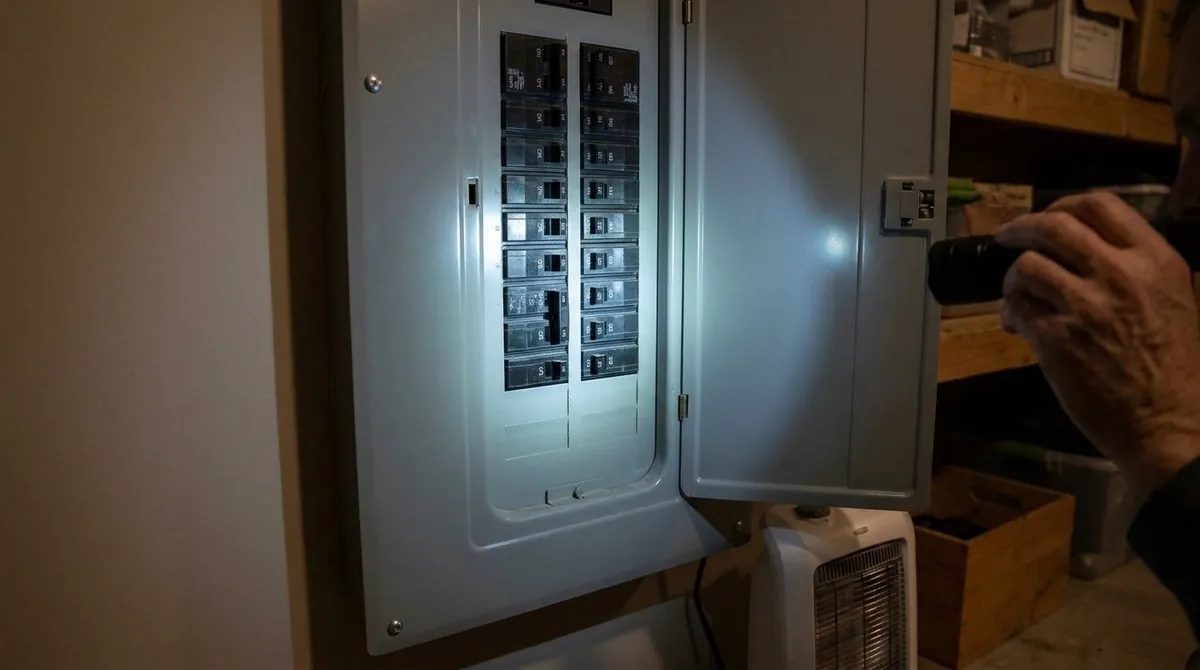
How to read the trip
Before you touch anything, think back to what happened just before the trip. The pattern points to the cause:
- It trips after running for a while, usually when the space heater, hair dryer or microwave is on: almost always an overload.
- It trips the moment you switch on one appliance: most likely a fault in that appliance or its cord.
- It trips the instant you reset it, even with everything unplugged: a short circuit or ground fault in the wiring itself. Stop here and read the section on when to call an electrician.
- It trips when it rains or after you hose down the deck: water in an outdoor receptacle, box or light fixture, a ground fault.
- A GFCI or AFCI breaker trips with no clear pattern: leakage from an appliance, a loose connection, or a wiring problem that only these breakers can detect.
- The main breaker trips: rare, and a job for an electrician. It points to a very high total load or a problem in the service equipment itself.
Overload: the most common reason a breaker keeps tripping
Most tripping breakers in homes are simply asked to carry too much. The arithmetic is short. At 120 volts, a 15 amp circuit can carry up to 1,800 watts and a 20 amp circuit up to 2,400 watts. For a load that runs three hours or more, such as a space heater left on all evening, the NEC treats it as a continuous load and the circuit should be loaded to no more than 80 percent: about 1,440 watts on 15 amps and 1,920 watts on 20 amps.
Now look at what plugs into a typical bedroom or bathroom circuit. A space heater on its high setting draws 1,500 watts, which is 12.5 amps on its own. Add a hair dryer, or a vacuum cleaner in the next room on the same circuit, and you are well past 15 amps. The breaker does not trip right away; it waits until the bimetal has heated up. That delay is exactly what makes an overload recognizable.
Kitchens show the same pattern with a toaster, a coffee maker and a microwave on one circuit. The fix is either to spread the load over different circuits or to have an electrician add a dedicated circuit for the appliance that keeps causing it.
Add up what really runs on one circuit with the circuit load calculator.
Never fix it with a bigger breaker
The breaker protects the wire in your wall, not the appliance. As a rule, 14 AWG copper wire is protected at no more than 15 amps and 12 AWG at no more than 20 amps (NEC 240.4(D)). Swap a 15 amp breaker for a 20 amp one on 14 AWG wire and the tripping stops, but the wire can now overheat inside the wall without anything switching it off. An oversized breaker on a small wire is one of the most dangerous things I came across in panels, and it is a regular entry among the 22 findings in every electrical inspection report.
Short circuit: when the breaker trips instantly
A short circuit trips the breaker immediately, often with a snap and sometimes with a flash at the outlet or the appliance. Common causes:
- A damaged appliance cord or plug, often one that has been pinched under furniture or a door.
- A screw or nail driven through a cable when someone hung a shelf or a picture.
- A wire that has come loose inside an outlet or switch box and touches another wire or the metal box.
- A failing appliance, such as a motor or heating element that has broken down inside.
Loose connections deserve a special mention, because they often start with heat long before they end with a short. Outlets wired through the small push in holes in the back are a frequent source, explained in our article on backstabbed outlets.
Do not keep resetting a breaker that trips instantly. Every reset sends the full fault current through the damaged spot again. Reset once to test, and if it trips straight away, leave it off.
Ground fault: when a GFCI keeps tripping
GFCI protection sits either in the breaker or in a GFCI receptacle with test and reset buttons. One GFCI receptacle can protect several ordinary outlets further down the circuit. So a dead bathroom outlet is sometimes reset at a GFCI receptacle in another bathroom, the garage or outside. Check those before you go to the panel.
When a GFCI keeps tripping, the usual causes are:
- Moisture in an outdoor receptacle, a weatherproof cover that does not close, or a box that fills with water.
- An older appliance that leaks a small current to ground, such as an aging freezer in the garage, a power tool or a heating element.
- Damaged insulation somewhere on the circuit.
A GFCI that trips is protecting someone. Replacing it with an ordinary receptacle to stop the tripping removes the protection the code requires in that spot. Our guide to GFCI requirements lists where the NEC wants it in your home.
Arc fault: when an AFCI breaker keeps tripping
AFCI breakers have the reputation of tripping for no reason. Sometimes that is true: certain older motors, vacuum cleaners and treadmills produce a current pattern that resembles arcing. Older circuits that share a neutral between two breakers can also upset an AFCI added later. More often, though, the AFCI has found something real: a loose connection, a nicked wire or a cable that was pierced by a fastener.
Many AFCI and dual function breakers show the cause of the last trip with an indicator light or a code. The meaning differs per manufacturer, so check the label on the breaker or the panel door. Do not swap an AFCI for a standard breaker to make the problem go away. The NEC requires AFCI protection in most living spaces of a home, and the tripping is often the only warning you will get.
When the breaker itself is the problem
Breakers wear out. After many trips, or with a poor connection where the breaker clips onto the bus or where the wire is clamped under the terminal, a breaker can run warm and trip below its rating. A breaker that feels hot to the touch, or a panel that smells of burned plastic, needs an electrician soon. Two wires clamped under one terminal is a related problem, explained in our article on double tapped breakers.
Some older panels have the opposite problem: breakers that do not trip when they should. If your panel is a Federal Pacific or Zinsco, a breaker that never trips is no reason for comfort. Read why Federal Pacific breakers fail before you rely on one.
Breaker keeps tripping: a safe way to narrow it down
You can do the first steps yourself without opening anything:
- Write down what was running and how long it ran before the trip.
- Unplug everything on that circuit and switch off its lights.
- Find the tripped breaker. It usually sits in a middle position. Push it firmly all the way to OFF first, then back to ON.
- If it trips again with nothing connected, stop. Leave it off and call an electrician.
- If it holds, plug things back in one at a time and switch them on, waiting a few minutes between each.
- If one appliance trips it every time, the fault is in that appliance. Have it repaired or replaced.
- If it only trips when several things run together, it is an overload. Move the heavy loads to other circuits or have a circuit added.
Two things never belong on this list: taping or wedging a breaker in the ON position, and installing a larger breaker.
When to call a licensed electrician
- The breaker trips immediately with nothing plugged in.
- You notice a burning smell, a scorched outlet, or a breaker or panel that feels warm.
- The breaker trips without any pattern you can link to an appliance or to the weather.
- The main breaker trips.
- An outdoor GFCI keeps tripping after the receptacle and cover have dried out.
- Spreading the load does not help because the house simply has too few circuits.
That last point is common in older homes that now run space heaters, window air conditioners and an EV charger on a panel designed for far less. Sometimes a few new circuits are enough; sometimes the service itself is too small. Our article on the 200 amp panel upgrade explains how to tell the difference.
Breaker keeps tripping: the short version
A breaker that keeps tripping is a message, not a malfunction. A delayed trip with heavy appliances running means overload. An instant trip means a short circuit or ground fault. A GFCI or AFCI that trips has usually found leakage or arcing that a standard breaker would miss. Unplug, reset once, add loads back one by one, and let the pattern guide you. If the breaker trips with nothing connected, smells hot or keeps tripping without a clear reason, leave it off and have a licensed electrician find the cause.
This article is general information about residential electrical systems, not a code ruling for your home. Code adoption varies by state and city, and your local electrical inspector has the final word. Have any work done by a licensed electrician.

Who writes this
FIXMIRO is written by Rahmouni, an industrial engineer who spent fifteen years inspecting electrical installations and seven inspecting gas. What you read here is what he used to explain to homeowners while standing at their panel, written out properly.
Use the free calculatorsOr browse all the guides.