

Backstabbed outlets are receptacles where the wires are pushed into small holes in the back instead of being wrapped around the side screws. It is fast, it is legal, and it is in millions of American homes. It is also, in my experience, one of the most common reasons an outlet suddenly stops working, a cover plate feels warm, or a light flickers when the vacuum cleaner starts. In fifteen years of inspecting electrical installations, loose connections caused more damage than almost any other single defect. Here is why push-in connections loosen, how to recognize the warning signs, and what the proper fix looks like.
Backstabbed outlets: what a push-in connection is
A standard receptacle gives the electrician two ways to connect a wire. The first is the side screw: strip the wire, bend it into a hook, wrap it clockwise around the screw and tighten. The second is the push-in terminal, the “backstab”: strip a straight piece of wire, push it into a hole in the back, and a small spring clip grabs it.
The push-in method saves a minute or two per outlet. On a new house with a hundred outlets, that adds up, which is why it is so common in tract housing from the 1970s onward.
Do not confuse backstabbing with back wiring. Better quality receptacles have holes in the back as well, but there the wire goes under a clamp plate that you tighten with the side screw. That is a solid, screw-pressure connection and a good choice. The cheap push-in hole with only a spring is the one that causes trouble.
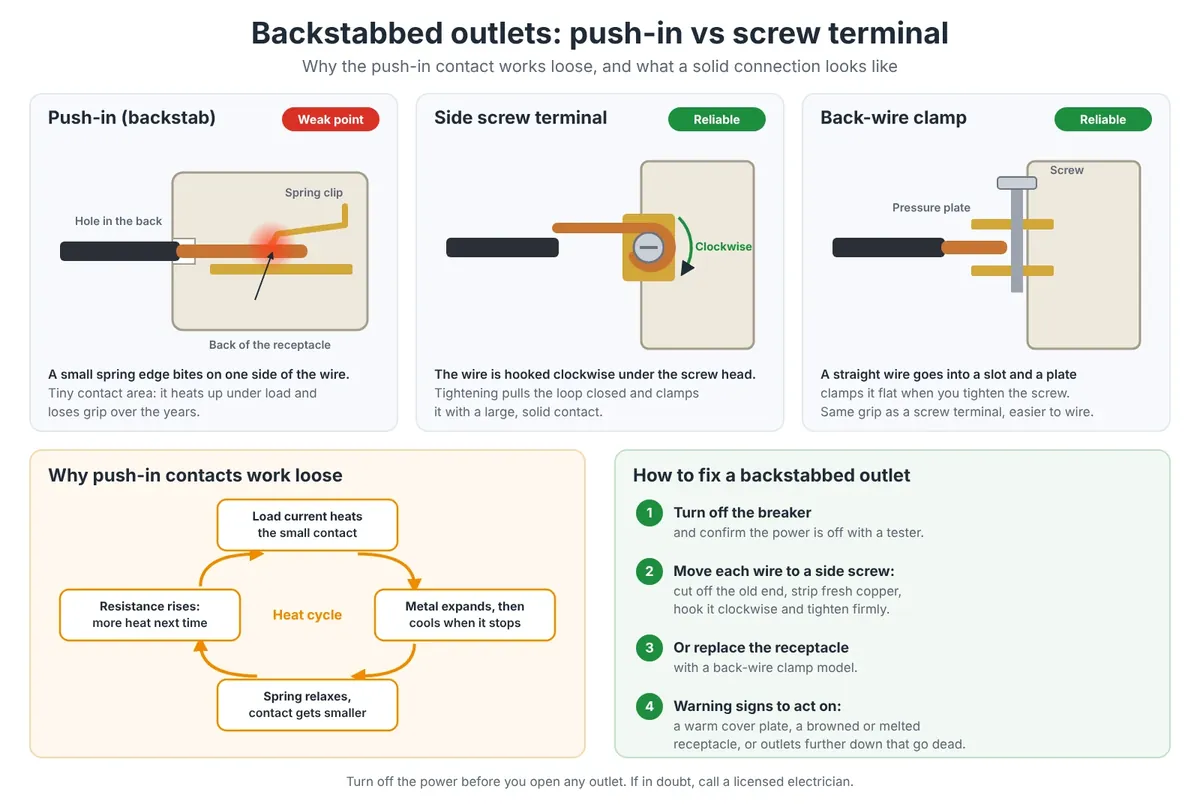
Why push-in connections work loose
A screw terminal presses a large area of the wire against a brass plate with real force. A push-in terminal touches the wire with the edge of a thin spring, over a contact area not much bigger than a pinhead. That is enough when the outlet is new. Over the years three things work against it:
- Heat cycles. Every time a space heater, hair dryer or vacuum runs, the connection warms up and cools down again. The metal expands and contracts, and the spring loses some of its grip each time.
- Movement. Plugging and unplugging pushes the receptacle back and forth in the box. The wire in the spring moves with it.
- Load. The spring contact is designed for limited current. Run a 1,500 watt heater on it for hours and it gets hotter than a screw terminal would.
Once a connection has a little extra resistance, it becomes a small heater of its own. More heat means more oxidation on the contact, more oxidation means more resistance, and the cycle feeds itself. That is how a loose connection goes from harmless to a blackened outlet.
Backstabbed outlets and wire size
On most receptacles sold today, the push-in holes only accept 14 AWG copper wire, the wire used on 15 amp circuits. They are not made for 12 AWG, the thicker wire on 20 amp circuits, and they are never for aluminum wire. The receptacle’s markings and instructions tell you what it is listed for, and the NEC requires equipment to be installed according to its listing and labeling (NEC 110.3(B)).
If you find 12 AWG wire forced into a push-in hole, or aluminum wire in one, that is not a matter of preference. It is a defect. Aluminum connections have their own problems, explained in our article on aluminum wiring replacement.
Signs of a loose connection
A loose connection rarely announces itself all at once. Watch for these signs:
- An outlet, or a whole row of outlets, that works one day and not the next.
- Lights that flicker or dim when a heavy appliance starts on the same circuit.
- A cover plate or a plug that feels warm to the touch.
- Brown or black discoloration around the slots or on the plate.
- A buzzing or crackling sound from the box.
- A smell of hot plastic, sometimes described as a fishy smell.
The first sign deserves extra attention. Electricians often feed the next outlet in the chain through the second set of push-in holes. If the connection at one outlet fails, every outlet after it goes dead. People then assume a tripped breaker or a bad GFCI, while the real cause is one tired spring clip somewhere in the middle of the run.
Warm, discolored or smelling outlets are not something to watch. Turn off the breaker for that circuit, stop using it, and have it checked.
Why your breaker does not catch it
A standard breaker trips on overload and short circuit. A loose connection is neither. The current on the circuit stays normal; it is only the connection that heats up. A 20 amp breaker will happily keep feeding a connection that is glowing inside the box.
An arc fault circuit interrupter, or AFCI, is designed to recognize the electrical signature of arcing, including the kind of arcing a loose connection can produce. That is a large part of why the NEC has expanded AFCI requirements over the years. Still, an AFCI is a safety net, not a repair. It cannot tighten a connection, and not every overheating connection arcs before it does damage.
The same logic applies at the panel. Two wires under a breaker terminal made for one is another loose connection waiting to happen, explained in our article on double tapped breakers.
How backstabbed outlets are fixed
The repair is simple in principle, and it is the kind of job a licensed electrician does in a few minutes per outlet:
- Switch off the breaker and confirm with a tester that the outlet is dead.
- Pull the wires out of the push-in holes. Most release with a small screwdriver in the slot next to the hole; otherwise the wire is cut off.
- Check the wire end. If it is discolored, brittle or nicked, cut it back to clean copper.
- Move the wires to the side screws, wrapped clockwise, or use a back wire receptacle with clamp plates.
- Where a receptacle feeds the next one in the chain, connect the wires together with a pigtail: one short wire from a wire connector to the outlet. The outlet then carries only its own load, and a failed outlet no longer kills the rest of the circuit.
- Replace any receptacle that shows heat damage. A scorched receptacle has lost its spring tension and its insulation.
- Tighten the screws to the torque marked on the device. Since the 2017 edition, the NEC requires a calibrated torque tool where the manufacturer gives a torque value (NEC 110.14(D)).
If one outlet in the house has a burned push-in connection, the others were installed the same day by the same person. It often makes sense to have them all redone at once, starting with the kitchen, laundry, bathrooms and any outlet that feeds a space heater or a window air conditioner.
When loose connections point to a bigger problem
Sometimes the outlet is only the place where an overloaded circuit shows itself. If you regularly run a heater, a microwave and a coffee maker on the same circuit, every connection on it works harder. Check what is actually on the circuit before blaming the outlet alone.
Add up what runs on one circuit with the circuit load calculator.
In an older house, a string of failing connections can also be a sign that the wiring as a whole is reaching its age. Our article on old house wiring helps you decide whether to repair or rewire. And loose and overheated connections are a regular entry among the 22 findings in every electrical inspection report.
Backstabbed outlets: the short version
Backstabbed outlets are legal, but they are the weakest connection in a typical house. A connection that has loosened will not trip your breaker, and it only gets worse with time. If you notice dead outlets, warm plates or flickering lights, have the push-in connections moved to the screws or pigtailed. It is a small job that removes one of the most common causes of electrical heat damage in a home.
This article is general information about residential electrical systems, not a code ruling for your home. Code adoption varies by state and city, and your local electrical inspector has the final word. Have any work done by a licensed electrician.

Who writes this
FIXMIRO is written by Rahmouni, an industrial engineer who spent fifteen years inspecting electrical installations and seven inspecting gas. What you read here is what he used to explain to homeowners while standing at their panel, written out properly.
Use the free calculatorsOr browse all the guides.