

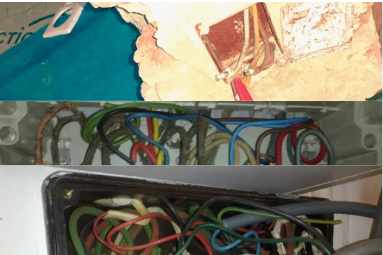
If your house went up between about 1965 and 1973, there is a fair chance the wire behind your outlets is aluminum rather than copper. Somebody has probably already told you it needs to come out. An electrician, a home inspector, or an insurance agent who suddenly wanted a lot more money.
Before you price a whole house rewire, it is worth knowing that the federal agency that studied this problem does not say aluminum wiring replacement is the only answer. It lists three permanent fixes, and tearing out every wire is only one of them. It also names two popular repairs that do not work, and one of those is probably what an electrician will offer you first.
Why your house has aluminum wiring in the first place
Nobody was cutting corners out of malice. In the mid sixties the price of copper climbed hard, and aluminum was cheap, light and plentiful. Building a house with aluminum branch circuits saved real money, the wire was listed and approved, and for roughly eight years it went into millions of homes.
The wire itself was not the mistake. The alloy used at the time, a utility grade aluminum known as AA-1350, behaved differently at a screw terminal than anybody had planned for. By the mid seventies the industry had moved to the AA-8000 series alloys, which do not have the same problem. That is why you still see aluminum today in service entrance cable and in the feeders to a range or a dryer, and why nobody worries about it there.
Aluminum does carry less current than copper for the same size, which is why an aluminum conductor is normally one or two sizes larger than the copper it replaces. If you want to see how that plays out on a real circuit, our wire derating guide explains why a nameplate ampacity is only a starting point. But that is a sizing question, not a safety defect. The trouble was always with the small branch circuit wire from that first generation, and specifically with its ends.
What actually goes wrong at the connection
Almost nothing goes wrong in the middle of the run. Aluminum carries current perfectly well. Every failure happens where the wire is clamped under a screw.
Four things pile up there. Aluminum expands and contracts more than copper does when a circuit heats up and cools down, so the wire works itself loose under the screw over years of daily use. Aluminum also creeps, meaning it slowly flows away from a sustained clamping pressure, so a terminal that was tight in 1969 is not tight now. Aluminum forms an oxide layer the moment it meets air, and unlike copper oxide that layer resists current instead of conducting it. And where aluminum touches a brass or steel terminal, the two dissimilar metals corrode each other in the presence of a little moisture.
The result is a joint that gets slightly resistive. Resistance makes heat, heat makes the joint looser, a looser joint makes more resistance. It runs away with itself quietly, inside a box, behind a cover plate, for years. Then one day the plastic scorches.
The 55 times figure, and what it does and does not mean
The number you will see quoted everywhere comes from the US Consumer Product Safety Commission. In its publication Repairing Aluminum Wiring, the CPSC states that homes built before 1972 with aluminum branch circuit wiring are 55 times more likely to have one or more connections at outlets reach what it calls Fire Hazard Conditions, compared with homes wired in copper.
Read that carefully, because it is routinely misquoted. It is not a claim that your house is 55 times more likely to burn down. It is a measurement of how often connections reach a dangerous condition. Most of those connections never start a fire. But the ones that do give no warning first, and that is the honest reason to take it seriously rather than the fire statistic.
It also means the risk lives at the terminations. Fix the terminations properly and you have fixed the problem, without touching the wire inside the walls. That single fact is what the rest of this article rests on.
Aluminum wiring replacement is only one of three approved fixes
The CPSC recognizes three permanent repairs.
Complete replacement with copper. The most thorough answer, and the agency says plainly that it may be impractical or prohibitively expensive for many homes. It means opening walls and ceilings, pulling new cable to every outlet, switch and fixture, then patching and repainting everything you opened. In a finished house it is a construction project, not an electrical job. We went through that decision in detail in old house wiring: do you really need to rewire?, and most of what applies there applies here.
The COPALUM crimp. A short copper pigtail is joined to the aluminum wire with a special crimp that cold welds the two metals into a gas tight connection, then gets an insulating sleeve. The copper tail is what goes under the device screw. The CPSC calls this method proven by more than a quarter century of field experience, and has said so publicly more than once. It requires a specific tool and a trained installer, which is its practical weakness rather than a technical one. Check what is actually available in your area before you count on it.
The AlumiConn connector. A small block with setscrews that clamps the aluminum wire and a copper pigtail separately, with a compound that handles the oxide. It is made by King Innovation. The CPSC accepts it while noting it is too new to have developed a significant long term safe performance history compared with the crimp. It needs only a torque screwdriver, so far more electricians can actually do it.
Notice what all three have in common. Every one of them ends with copper under the device screw. That is the whole point.
What the CPSC says does not work
Two repairs get offered constantly, and the agency has tested both and rejected both.
Ordinary twist on wire connectors. Pigtailing copper to aluminum with the usual wire nut, including the ones marked for aluminum, looks like the cheap version of the same idea. In CPSC testing substantial numbers of these connectors overheated severely. The agency states that this method does not solve the problem of overheating. If somebody quotes you a low price to pigtail your whole house, ask which connector. This is the answer you do not want to hear.
CO/ALR switches and receptacles. These devices are built to take aluminum directly and they do perform better than ordinary devices. But they have failed in laboratory tests when connected to aluminum wire, and the CPSC calls them, at best, an incomplete repair. They also do nothing at all for the splices inside your junction boxes, which is where a good share of the bad connections actually are. Plenty of homeowners believe swapping in CO/ALR outlets has solved their problem. It has not.
What it costs
Prices vary too much by region and by house for anyone to quote you a number that means something, so treat these as the shape of the decision rather than a budget.
A full aluminum wiring replacement in a finished house is usually the most expensive option by a wide margin, because most of the money is not electrical work at all. It is access, drywall and paint. The larger the house and the more finished the basement, the worse the ratio gets.
A crimp or connector repair is priced per connection, and a typical house has somewhere between fifty and a hundred of them once you count every receptacle, switch, fixture and junction box. It is usually a fraction of a rewire, and it is done in days rather than weeks, with no walls opened beyond the occasional buried box.
There is a third path worth knowing about: repair now, replace gradually. Every time you remodel a room down to the studs, the new wire in that room is copper. Over fifteen years most of the house converts itself while you were going to open those walls anyway.
Before you add anything to an aluminum circuit
Every repair above fixes the connections. None of them makes the circuit bigger. A house from 1970 was wired for a fraction of what a house draws today, and an aluminum joint that has been quietly degrading for fifty years is exactly the wrong place to add load.
So before you put a window air conditioner, a space heater or a second freezer on an old circuit, add up what is already on it with our circuit load calculator. If you are thinking about a car charger, check the whole service first rather than the one circuit. And if the run is long, for instance out to a garage or a shed, the resistance of aluminum shows up as voltage drop sooner than it would in copper. We worked a long run through from start to finish in wire size for a 300 foot run.
Your insurer has its own opinion
This is often what forces the issue, and it does not always follow the CPSC.
Some carriers decline a house with aluminum branch circuits outright. Some write it with a surcharge. Many will write it normally once the connections have been repaired by an approved method and they have a letter from a licensed electrician saying so. A few insist on a full rewire regardless of what the federal agency accepts, because their underwriting rules were written that way and nobody has revisited them.
So before you choose a repair, call your carrier and ask what specifically they will accept, in writing. Doing three thousand dollars of correct work that your insurer does not recognize is a worse outcome than doing nothing and shopping for a different carrier.
Whatever you have done, keep the paperwork. The electrician’s letter, the permit, the inspection sign off. It is worth money at renewal and again when you sell.
How to tell what you have
Start with what you can check without touching anything live.
The year the house was built is the strongest clue. Between roughly 1965 and 1973 puts you in the window. Before or well after, and it is unlikely.
Look in your panel with the door open but the cover on. Where cables enter, the jacket is printed with the conductor material. Aluminum cable of that era usually says ALUMINUM or AL right on it. Copper cable will say something else or nothing at all.
While you are at the panel, check the brand. Aluminum branch circuits and Federal Pacific Stab Lok panels came out of the same decade and often sit in the same house. If you find one, that panel is a separate conversation, and arguably a more urgent one, because the failure mode there is the breaker itself rather than a connection you can repair.
What not to do is pull receptacles out of the wall to look. The whole hazard of this wiring lives at those terminals, and a loose one is exactly what you would be disturbing. Have an electrician open a representative sample. It costs an hour and it tells you far more than a guess.
What to ask before you sign
Five questions will separate a proper repair from an expensive one that fixes nothing.
Which method are you using, by name. If the answer is a wire nut or CO/ALR devices, you now know what the CPSC says about both.
Does every connection get done, including the splices in junction boxes and the fixture connections in ceilings, or only the receptacles you can reach easily. A partial repair leaves the bad joint you did not visit.
Are you pulling a permit and having it inspected. On a job this size in most jurisdictions you should be.
What do you leave me on paper afterwards, and will it satisfy a home insurer.
And finally, what did you find. A good electrician will tell you which connections were already discolored or loose. That is the real report on your house, and it is worth more than the quote. Our guide to the 22 findings in an electrical inspection report covers how that language usually reads.
The short version
Aluminum branch circuit wiring from the late sixties is a genuine hazard, and it is a hazard at the terminations rather than in the wire. Full aluminum wiring replacement is the most complete answer and rarely the sensible one in a finished house. A crimp or connector repair at every connection is recognized as permanent, costs far less, and is what most homeowners should be pricing. The cheap pigtail with a wire nut and the CO/ALR outlet swap are the two answers to refuse, no matter how confidently they are offered.

Who writes this
FIXMIRO is written by Rahmouni, an industrial engineer who spent fifteen years inspecting electrical installations and seven inspecting gas. What you read here is what he used to explain to homeowners while standing at their panel, written out properly.
Use the free calculatorsOr browse all the guides.