

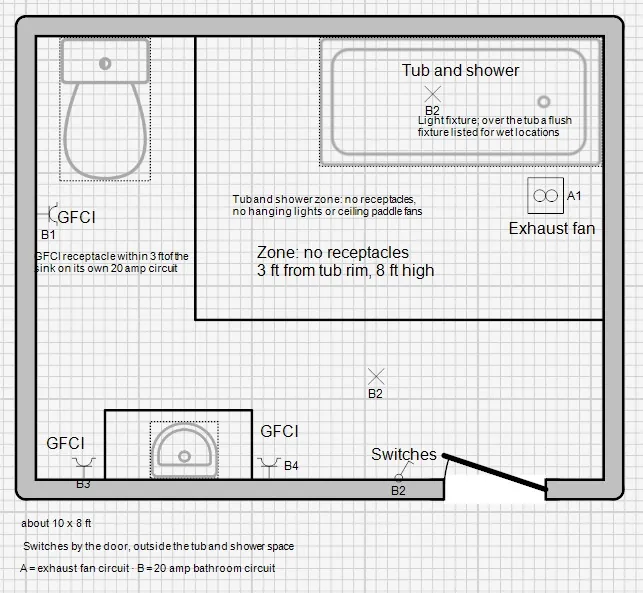
Bathroom electrical safety is solved in two very different ways on the two sides of the Atlantic. In the United States, the code protects the bathroom one device at a time: this receptacle needs a GFCI, that light fixture needs a wet location listing, no outlet within 3 feet of the tub. In Europe, the starting point is the room itself: there is water here, so every circuit in it gets shock protection, and the closer you get to the tub, the stricter the rules become.
I inspected electrical installations in Belgium for fifteen years, under the AREI, the Belgian electrical code, which is built on the same European principles. When I started writing about the NEC for American homeowners, the bathroom was where the difference struck me most. Neither system is careless. But each one has something the other could learn from.
Bathroom electrical safety in the United States: device by device
The American rules grew out of accidents. Decades ago, people were killed when a hair dryer or a radio ended up in the bathtub. The code answered by requiring GFCI protection for bathroom receptacles, because that is where those appliances plug in. Since then, the list has grown edition after edition: kitchens, laundry areas, garages, basements, outdoor outlets, and a growing list of appliances. We covered that list in detail in GFCI requirements: where the NEC wants GFCI protection in your home.
In a bathroom today, the NEC asks for GFCI protection on every receptacle. Since the 2020 edition, it also keeps receptacles out of a zone reaching 3 feet horizontally and 8 feet vertically from the top of the bathtub rim or shower threshold, including the space directly over the tub. Hanging light fixtures, track lighting and ceiling fans with lights are kept out of that same zone, and fixtures installed over the tub or shower have to be listed for damp or wet locations. Switches are not allowed inside the tub or shower space.
So there is a zone in American bathrooms too, and despite the name it is a volume, a box of space around and above the tub. But the protection itself still follows the device: the receptacle has a GFCI, the ceiling light on its own circuit usually does not.
Bathroom electrical safety in Europe: the room decides
The European standard for bathrooms, IEC 60364-7-701, starts from a different question: where can water and people meet? It divides the space around the tub or shower into three volumes. The standard calls them zones; the Belgian code calls them volumes, which describes them better, because each one is a space with a height as well as a width.
Zone 0 is the inside of the tub or shower tray. Only equipment made for it is allowed there, running on safety extra low voltage of no more than 12 volts AC, and it has to withstand immersion.
Zone 1 is the space directly above the tub or tray, up to about 7 feet 4 inches (2.25 m) above the floor. Only fixed equipment made for this zone is allowed, such as an electric shower or a suitable light fixture, protected at least against splashing water. No receptacles, and in practice no switches.
Zone 2 is a band about 2 feet (0.6 m) wide around zone 1. Fixed lights, fans and heaters are allowed if they are protected against splashing. Ordinary receptacles are not; only special shaver outlets with their own isolating transformer.
And then comes the rule that makes the real difference: in a room with a bath or shower, every circuit has to be protected by a residual current device, the European equivalent of a GFCI, that trips at 30 milliamps or less. Not only the receptacles. The lights, the fan, the towel heater, the floor heating, everything. The only exceptions are circuits that are already inherently safe, such as safety extra low voltage.
In Belgium, where I inspected, the whole house also sits behind a main residual current device at the service. So even a circuit that has nothing to do with the bathroom has a second line of defense against ground faults.
The two systems side by side
| United States (NEC) | Europe (IEC 60364) | |
|---|---|---|
| Voltage to ground | 120 volts | 230 volts |
| Shock protection device | GFCI, trips at about 5 milliamps | Residual current device, 30 milliamps or less |
| What it protects in a bathroom | The receptacles, and certain equipment such as floor heating or a hot tub | Every circuit in the room |
| Zones around the tub | One zone, 3 feet out and 8 feet up, for receptacles and certain fixtures | Zones 0, 1 and 2, each with its own rules for voltage, water protection and equipment |
| Receptacles near the tub | Not within the zone, GFCI everywhere in the bathroom | Not in zones 0, 1 or 2, except shaver outlets in zone 2 |
| Whole house | No shock protection device at the service | Often a main residual current device, as in Belgium |
One detail surprises most Europeans: the American GFCI is more sensitive. It trips at about 5 milliamps, where the European device in a bathroom trips at 30. And American homes run at 120 volts to ground instead of 230, so a shock drives less current through the body. On those two points, the American receptacle is the safer one.
What American homes can learn from Europe
The hazard is the water, not the receptacle. A light fixture in a shower that lets in water, a fan whose housing has corroded, a towel warmer with a damaged cord: none of those is a receptacle, and in many American bathrooms none of them is on a GFCI. The European rule avoids the question by protecting the whole room, and that is the core of European bathroom electrical safety.
Nothing in the NEC stops you from doing the same. When a bathroom is remodeled, you can ask your electrician to put every bathroom circuit on GFCI protection, the lights and the fan included, with a GFCI breaker or a dual function breaker in the panel. It costs little extra on a remodel, and it closes the gap the device by device approach leaves open.
Think in zones when you choose equipment. The closer a fixture is to the water, the better it has to resist it. A recessed light right above the shower should be listed for wet locations, not just damp, and anything within reach of someone standing in the tub deserves a second look.
Protection you cannot see is still protection you have to test. A GFCI breaker in the basement protects the bathroom lights, but nobody walks down to press its test button. Once a month is the manufacturers’ advice, for breakers as well as receptacles.
What Europe could learn from America
Bathroom electrical safety is not a one way lesson. The American GFCI at the receptacle does two things well. It trips at a much lower current, which gives a bigger safety margin for the person holding the appliance. And it sits where the appliance is used, with a test and reset button in plain sight, so people actually use it. A European protective device hidden in the panel is tested far less often than it should be, in my experience rarely, if ever, by the people who live with it.
Bathroom electrical safety in an older American home
Many American bathrooms were wired before GFCI protection was required at all, or before the 3 foot zone existed. That is not automatically a violation; the code in force when the house was built still applies to what was installed then. But from a bathroom electrical safety point of view, three questions are worth asking.
Does every bathroom receptacle trip when you press TEST on it, or on the GFCI that protects it? Is there a receptacle so close to the tub that someone could use it while standing in the water? And is there any light or fan in the shower area that was not made for a wet location?
Missing GFCI protection near water is one of the most common items in a home inspection, and it is on our list of the 22 findings in every electrical inspection report. In an older house without grounding, a GFCI receptacle is also the simplest way to add real shock protection, as explained in old house wiring: do you really need to rewire? And if your bathroom project includes a spa or hot tub outside, the rules for that are in hot tub wiring.
Bathroom electrical safety: the short version
American bathroom electrical safety protects the devices where accidents happened: GFCI on the receptacles, a zone around the tub, wet location fixtures in the shower. European rules protect the room: every circuit behind a 30 milliamp device, and zones that tighten the rules as you get closer to the water. The American GFCI is more sensitive and runs at a lower voltage; the European approach leaves no circuit in the bathroom unprotected.
You can have the best of both. Meet the NEC, and when you remodel, ask for GFCI protection on every circuit in the bathroom, not only the receptacles. Then press the test buttons once a month.
This article is general information about residential electrical systems, not a code ruling for your home. Code adoption varies by state and city, and your local electrical inspector has the final word. Have any work done by a licensed electrician.

Who writes this
FIXMIRO is written by Rahmouni, an industrial engineer who spent fifteen years inspecting electrical installations and seven inspecting gas. What you read here is what he used to explain to homeowners while standing at their panel, written out properly.
Use the free calculatorsOr browse all the guides.